Can You Still Use T Test if You Know the Standard Devation
Standard Deviation Reckoner
Please provide numbers separated by commas to calculate the standard difference, variance, mean, sum, and margin of error.
Standard departure in statistics, typically denoted past σ, is a mensurate of variation or dispersion (refers to a distribution's extent of stretching or squeezing) between values in a set of information. The lower the standard deviation, the closer the data points tend to exist to the mean (or expected value), μ. Conversely, a higher standard deviation indicates a wider range of values. Similar to other mathematical and statistical concepts, there are many dissimilar situations in which standard deviation can be used, and thus many different equations. In improver to expressing population variability, the standard divergence is also often used to measure statistical results such as the margin of fault. When used in this manner, standard deviation is oft called the standard error of the mean, or standard error of the gauge with regard to a hateful. The calculator above computes population standard deviation and sample standard deviation, every bit well as conviction interval approximations.
Population Standard Difference
The population standard deviation, the standard definition of σ, is used when an entire population can be measured, and is the square root of the variance of a given data set. In cases where every member of a population can be sampled, the post-obit equation can be used to find the standard difference of the entire population:
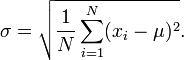
xi is an individual value
μ is the mean/expected value
Northward is the total number of values
For those unfamiliar with summation notation, the equation in a higher place may seem daunting, merely when addressed through its private components, this summation is not particularly complicated. The i=1 in the summation indicates the starting index, i.e. for the data set 1, three, 4, seven, 8, i=ane would be 1, i=2 would be 3, and so on. Hence the summation notation but means to perform the performance of (xi - μ2) on each value through N, which in this case is v since there are 5 values in this data set.
EX: μ = (i+iii+4+vii+8) / five = 4.6
σ = √[(1 - 4.6)ii + (iii - four.half-dozen)2 + ... + (8 - 4.6)ii)]/five
σ = √(12.96 + two.56 + 0.36 + v.76 + 11.56)/five = 2.577
Sample Standard Deviation
In many cases, information technology is not possible to sample every fellow member within a population, requiring that the higher up equation be modified so that the standard deviation tin can be measured through a random sample of the population being studied. A mutual estimator for σ is the sample standard deviation, typically denoted past s. It is worth noting that there exist many different equations for calculating sample standard difference since, unlike sample mean, sample standard deviation does not take any unmarried estimator that is unbiased, efficient, and has a maximum likelihood. The equation provided below is the "corrected sample standard deviation." It is a corrected version of the equation obtained from modifying the population standard deviation equation by using the sample size as the size of the population, which removes some of the bias in the equation. Unbiased interpretation of standard deviation, however, is highly involved and varies depending on the distribution. Equally such, the "corrected sample standard departure" is the most commonly used calculator for population standard divergence, and is generally referred to as but the "sample standard departure." It is a much better estimate than its uncorrected version, but still has a meaning bias for small sample sizes (Northward<ten).
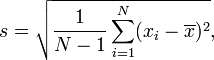
xi is one sample value
x̄ is the sample mean
Northward is the sample size
Refer to the "Population Standard Deviation" section for an example of how to work with summations. The equation is essentially the same excepting the Northward-1 term in the corrected sample deviation equation, and the apply of sample values.
Applications of Standard Deviation
Standard departure is widely used in experimental and industrial settings to test models against existent-world data. An example of this in industrial applications is quality control for some products. Standard deviation can be used to calculate a minimum and maximum value within which some aspect of the product should fall some high percent of the time. In cases where values fall outside the calculated range, it may exist necessary to make changes to the product process to ensure quality control.
Standard deviation is also used in weather to decide differences in regional climate. Imagine two cities, one on the declension and i deep inland, that take the aforementioned mean temperature of 75°F. While this may prompt the conventionalities that the temperatures of these two cities are near the aforementioned, the reality could be masked if simply the hateful is addressed and the standard departure ignored. Coastal cities tend to have far more than stable temperatures due to regulation past large bodies of h2o, since water has a higher heat capacity than land; essentially, this makes h2o far less susceptible to changes in temperature, and littoral areas remain warmer in winter, and cooler in summertime due to the amount of energy required to change the temperature of the water. Hence, while the coastal city may accept temperature ranges between sixty°F and 85°F over a given period of time to result in a mean of 75°F, an inland urban center could have temperatures ranging from 30°F to 110°F to result in the same hateful.
Some other area in which standard deviation is largely used is finance, where it is oftentimes used to mensurate the associated adventure in price fluctuations of some nugget or portfolio of avails. The use of standard difference in these cases provides an estimate of the uncertainty of time to come returns on a given investment. For case, in comparing stock A that has an boilerplate render of 7% with a standard divergence of 10% against stock B, that has the aforementioned average render but a standard difference of fifty%, the kickoff stock would clearly be the safer option, since the standard divergence of stock B is significantly larger, for the exact same return. That is not to say that stock A is definitively a better investment selection in this scenario, since standard divergence can skew the hateful in either direction. While Stock A has a higher probability of an boilerplate return closer to 7%, Stock B tin potentially provide a significantly larger return (or loss).
These are just a few examples of how one might use standard deviation, but many more exist. Generally, calculating standard deviation is valuable whatsoever fourth dimension it is desired to know how far from the mean a typical value from a distribution tin be.
Can You Still Use T Test if You Know the Standard Devation
Source: https://www.calculator.net/standard-deviation-calculator.html
0 Response to "Can You Still Use T Test if You Know the Standard Devation"
Post a Comment