What Happened Because of the Baby Boom? How Did William Levitt Help With This?
| William Levitt | |
|---|---|
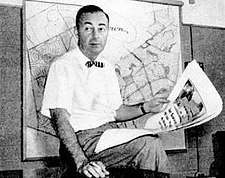 1964 | |
| Born | William Jaird Levitt (1907-02-xi)February eleven, 1907 New York Urban center, New York, U.S. |
| Died | Jan 28, 1994(1994-01-28) (anile 86) Manhasset, New York, U.S. |
| Occupation | Existent manor developer |
| Employer | Levitt & Sons |
| Known for | American suburban development |
| Spouse(south) | Rhoda Kirshner (divorced) Alice Kenny (divorced) Simone Korchin |
| Children | 2 |
William Jaird Levitt (February xi, 1907 – January 28, 1994) was an American existent-estate developer and housing pioneer. Equally president of Levitt & Sons, he is widely credited as the father of modern American bourgeoisie. He was named ane of Time Magazine's "100 Almost Influential People of the 20th Century."[one]
Early life and instruction [edit]
Levitt was born in 1907 to a Jewish family in Brooklyn.[2] His generation was the second since emigrating from Russia and Austria;[iii] the paternal grandparents who immigrated to the United states had been a rabbi grandfather from Russian federation and a grandmother from Austria-Germany.[4] His father was Abraham Levitt, a Brooklyn-born[5] real estate attorney and part-time investor; his mother was Pauline Biederman. A younger brother, Alfred, was built-in when William was 5 years old. William received a public schoolhouse education at Public School 44 and Boys High School.[2] He and then attended New York Academy for three years, merely dropped out earlier graduating.[2] [5]
Levitt & Sons [edit]
1920s–1930s [edit]
In 1929, William's male parent Abraham founded a existent-estate development visitor chosen Levitt & Sons. Levitt & Sons congenital mostly upscale housing on and effectually Long Island, New York, in the 1930s. William Levitt served equally company president, overseeing all aspects of the company except for the designs of the homes they built, which fell to William's blood brother Alfred.[5]
Afterwards World War II [edit]
During World War II, Levitt served in the Navy as a lieutenant in the Seabees. After returning from the war, he saw a need for affordable housing for returning veterans. America'south post-state of war prosperity and infant boom had created a crisis of affordable housing.[6]
Even earlier returning from the war, Levitt experimented with mass housing projects, building a ane,600-domicile customs in Norfolk, Virginia, which was non a success – units remained unsold in 1950.[5] Levitt & Sons' first successful housing development was located on nearly 20 square miles (52 km2) of land near Hempstead, Long Island and was named Levittown. The associates line structure method enabled Levitt to build more efficiently than other developers at the time, with teams of specialized workers following each other from business firm to house to consummate incremental steps in the construction.[7] Levitt also reduced costs by freezing out union labor – a move which provoked picket lines – enabling him to use the latest engineering science, such as spray painting. He besides cut out middlemen and purchased many items, including lumber and televisions, straight from manufacturers, as well as constructing his own mill to produce nails. The building of every house was reduced to 27 steps,[vii] and sub-contractors were responsible for each step. His mass production of thousands of houses at virtually the same time immune Levitt to sell them, fully furnished with modernistic appliances, for equally little as $eight,000 each ($65,000 in 2009 dollars), which, with the G.I. Nib and Federal housing subsidies, reduced the up-front end cost of a firm to many buyers to around $400.[5]
Levitt was the embrace story in Time magazine for July 3, 1950, with the tag line "For Sale: a new way of life."[8]
Equally Levitt & Sons' president, Levitt proposed and constructed other Eastward Declension developments throughout the 1960s. In 1952, people started buying over 17,000 Levitt-built homes in Bucks County, Pennsylvania. In improver, the visitor built Willingboro, New Jersey, which notwithstanding has street names such as Levitt Parkway. During the late 1950s, Levitt and Sons constructed "Belair at Bowie" in Bowie, Maryland. In the early 1960s, the company built a five,000-firm community in north central New Jersey called Strathmore-at-Matawan.
William took control of Levitt & Sons in 1954, after splitting with Alfred.[2] The company went public in 1960. During the 1960s, when Levitt was leading the company, Levitt & Sons adult properties beyond the American mainland, such as Levittown, Puerto Rico; Lésigny, France in Seine-et-Marne; and Mennecy in Essonne, France.[ix]
Past the late 1960s, Levitt had become ane of the richest men in America, with a fortune estimated in excess of $100 million. He lived in a lavish 30-room mansion on his "La Coline" manor in Mill Neck, New York, and spent much of his time on La Belle Simone, his 237 feet (72 yard) yacht named subsequently his third wife.[x]
Racial segregation [edit]
Levitt refused to integrate his developments. The Jewish Levitt barred Jews from Strathmore, his get-go pre-Levittown development on Long Isle in New York, and he refused to sell his homes to African Americans. His sales contracts too forbade the resale of properties to blacks through restrictive covenants, although in 1957 a Jewish couple resold their firm to the outset blackness family to live in a Levitt home.[11] Levitt's all-white policies likewise led to civil rights protests in Bowie, Maryland in 1963.[x] [12] The National Association for the Advocacy of Colored People and the American Civil Liberties Matrimony opposed Levitt'south racist policies, and the Federal Housing Administration prepared to refuse mortgages on his adjacent Levittown. Nevertheless, Levitt would not back downwardly and continued planning another whites-only Levittown in Willingboro Township, New Jersey. He fought legal challenges in New Jersey courts until the Us Supreme Court refused to hear his case.[13]
The 2003 PBS serial Race: The Power of an Illusion, by California Newsreel, features Levittown and nearby Roosevelt in documenting systemic racism in the development of the early suburbs.
Levitt has been criticized for his racially discriminatory policies when providing housing, which were especially discriminatory to African Americans, Asian Americans, Hispanic Americans and Native Americans.
Visitor sale [edit]
After he had congenital over 140,000 houses around the world, then lx-year-quondam Levitt sold the company to ITT for $92 million ($710 million today) in July 1967, of which $62 meg was in the form of ITT stock. ITT made Levitt president of the renamed Levitt Corp., with a not-compete clause where Levitt could not constitute or be employed by another Us habitation building company for ten years.[7] He entered the agreement thinking he would play an active part in ITT affairs, but executives felt Levitt was besides one-time to take on more responsibility.[12]
Levitt remained president under ITT until 1972. During that time he led the subsidiary's development of housing projects in Palm Declension, Florida; Richmond, Virginia; and Fairfax, Virginia.[ citation needed ]
Later years and death [edit]
Afterwards the restriction against Levitt moving to a new home edifice company in the U.s. expired, he was unable to echo the success he had accomplished with Levitt & Sons. He established a serial of companies and joint ventures through the 1970s and 1980s[fourteen] which failed. The ITT stock he often used for collateral on these ventures lost 90% of its value, saddling him with great debt.[2]
The Levitt Corp. had their license to acquit business organisation in Prince George'due south County, Maryland revoked in Oct 1978 later on building inspectors found more than 2,500 code violations in 122 homes of their latest subdivision, Northview.[15]
He was accused of misappropriation of funds from the charitable Levitt Foundation and agreed to repay $v million,[16] more than $5 million[two] or $11 million (in 1992).[17]
Levitt died from kidney disease at a hospital in Manhasset, New York on January 28, 1994, at the historic period of 86.[ii] [12]
Legacy [edit]
William Levitt came to symbolize the new suburban growth with his employ of mass-production techniques to construct big developments of houses, eponymously named Levittowns, selling for under $10,000. Many other relatively cheap suburban developments soon appeared throughout the land. While he did not invent the building of communities of affordable single-family unit homes inside driving distance of major areas of employment, his innovations in providing affordable housing popularized this type of planned community in the years post-obit Globe War II.[seven]
His nicknames included "The King of Suburbia" [xviii] and "Inventor of the Suburb." At his height, when he was completing one suburban business firm every 11 minutes,[xix] Levitt compared his successes to those of Henry Ford's automobile associates line.[18] Time mag recognized Levitt as i of the "100 Well-nigh Of import People of the 20th Century" in 1998.[7]
Levitt was awarded the Frank P. Brown Medal in 1965.
Personal life [edit]
Levitt married Rhoda Kirshner in Nov 1929.[20] Their son William Junior was built-in in 1933, and their second son, James, was born in 1944. The couple divorced in 1959, and Levitt married his secretarial assistant and long-time mistress, Alice Kenny. Ten years later, in 1969, Levitt divorced her and married a French art dealer, Simone Korchin.[2]
References [edit]
- ^ "Time 100 Persons Of The Century". Time. June 6, 1999.
- ^ a b c d e f g h Step, Eric (Jan 29, 1994). "William J. Levitt, 86, Pioneer of Suburbs, Dies". The New York Times. ISSN 0362-4331. Retrieved 2017-07-26 .
- ^ Ephross, Peter (February nine, 2009). "How Jews both Segregated and Integrated Levittown". Baltimore Jewish Times. Archived from the original on June 8, 2011. Retrieved December iii, 2014.
- ^ Ferrer, Margaret Lundrigan; Navarra, Tova (1997-03-01). Levittown: The First 50 Years. Arcadia Publishing. ISBN9780738562285.
- ^ a b c d e Glaeser, Edward (2011), Triumph of the City: How Our Best Invention Makes Us Richer, Smarter, Greener, Healthier, and Happier, New York: Penguin Press, pp. 174–77, ISBN978-1-59420-277-3
- ^ Blackwell, Jon. "1951: American dream houses, all in a row". The Trentonian.
- ^ a b c d e Lacayo, Richard (Dec 7, 1998). "Suburban Legend William Levitt". Fourth dimension. Archived from the original on Apr 8, 2011. Retrieved October i, 2010.
- ^ Staff (July 3, 1950). "House Architect Levitt, For Sale: a new way of life". Fourth dimension. Archived from the original on December 2, 2006.
- ^ Staff (December 10, 1965). "France: A Lesson from Levitt". Time. Archived from the original on April 22, 2008. Retrieved 2011-01-eleven .
- ^ a b "William Levitt". Entrepreneur.com . Retrieved 2015-11-xx .
- ^ Ephross, Peter (February 9, 2009) "How Jews both Segregated and Integrated Levittown" Baltimore Jewish Times
- ^ a b c "William Levitt" Your Dictionary
- ^ Jacobson, Joanne (Apr fourteen , 2009) "Jew vs Jew in Levittown" The Forwards
- ^ "Levitt Communities". LevittownBeyond.com. Retrieved three Dec 2014.
- ^ Diehl, Jackson (October xiv, 1978). "The Ascent And Fall of Levitt Era". The Washington Mail . Retrieved October 14, 2019.
- ^ Kaufman, Michael T. (September 24, 1989). "Tough Times For Mr. Levittown". The New York Times.
- ^ "William J. Levitt, Pioneer of Postwar Suburbia, Dies". The Washington Post. Jan thirty, 1994.
- ^ a b Schneiderman, Matt (Apr thirty, 2008). "William Levitt: The king of suburbia". The Existent Deal.
- ^ Halberstam, David (1997) The Fifties: "The Fear and the Dream" (documentary)
- ^ Kushner, David (2009-07-01). Levittown: 2 Families, One Tycoon, and the Fight for Ceremonious Rights in America's Legendary Suburb. Bloomsbury Publishing USA. ISBN9780802719737.
External links [edit]
- New York Times obituary
- William Levitt at Find a Grave
What Happened Because of the Baby Boom? How Did William Levitt Help With This?
Source: https://en.wikipedia.org/wiki/William_Levitt
0 Response to "What Happened Because of the Baby Boom? How Did William Levitt Help With This?"
Post a Comment